
Why Your Best People Stop Telling You the Truth Long Before They Leave
Jun 26, 2026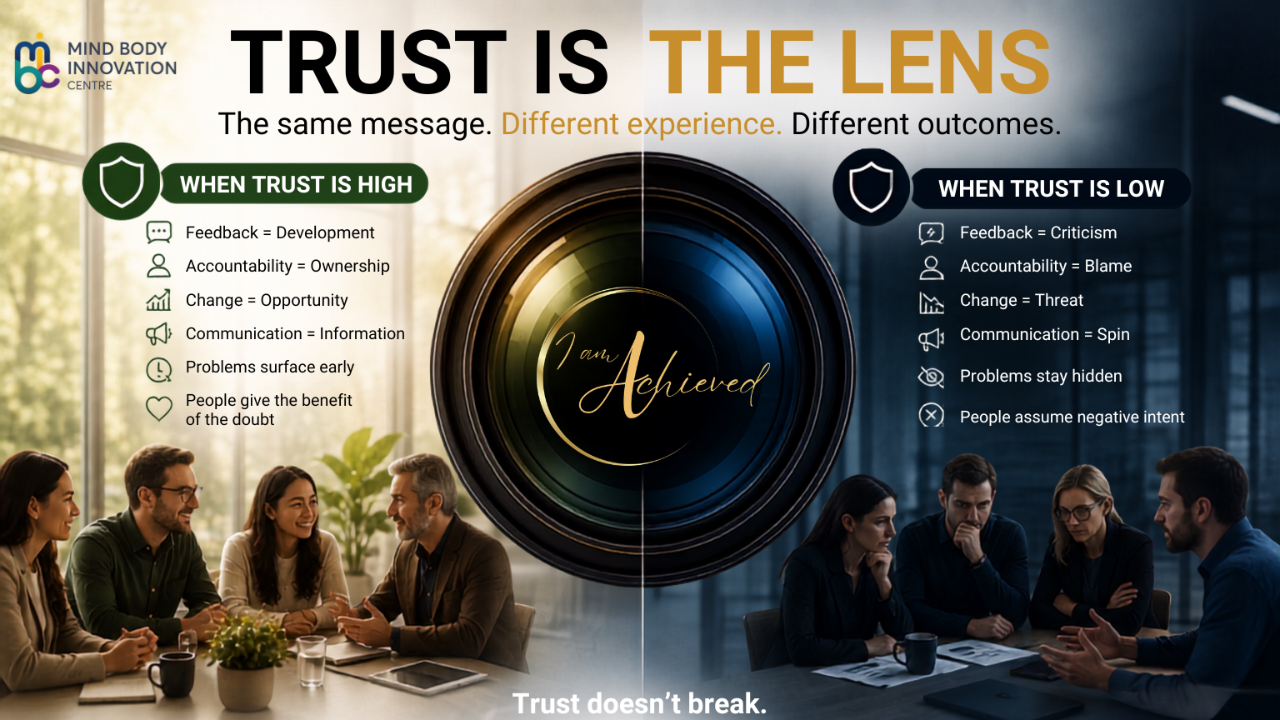
Why Your Best People Stop Telling You the Truth Long Before They Leave
A leader I was working with recently told me they had a communication problem.
People weren’t speaking up.
Change initiatives were meeting resistance.
The same frustrations kept appearing in engagement surveys.
And despite repeated efforts to communicate more clearly, things didn’t seem to be improving.
As we explored it further, I asked a simple question.
“Do you think this is really a communication problem?”
The room went quiet.
A few moments later someone replied:
“I think people just don’t trust us anymore.”
That changed the entire conversation.
Because communication problems and trust problems can look remarkably similar on the surface.
But they are very different underneath.
And one is significantly more expensive than the other.
The Hidden Cost of Low Trust
Most organisations think about trust as a culture issue.
I think that’s a mistake.
Trust is an operational asset.
It influences how quickly problems are identified, how effectively teams adapt to change, how much accountability people are willing to accept, and how openly people communicate with one another.
But perhaps its greatest influence is this:
Trust determines whether people tell leaders the truth.
In healthy organisations, bad news travels quickly.
Problems are identified early.
Concerns are raised before they become crises.
Leaders get access to reality.
When trust declines, the opposite happens.
People become more cautious.
Concerns stay in small conversations.
Risks remain hidden.
Leaders receive filtered information.
And decisions begin getting made without a full understanding of what is actually happening on the ground.
That’s why the greatest cost of low trust isn’t disengagement.
It’s organisational blindness.
What Trust Looks Like
One of the challenges with trust is that nobody talks about it when it’s working.
You simply see it in behaviour.
When trust is strong:
- People raise concerns early.
- Teams take ownership of mistakes.
- Healthy disagreement is possible.
- Feedback is viewed as development rather than criticism.
- Accountability feels fair.
- People generally assume positive intent.
- Leaders hear difficult truths before they become major problems.
You won’t hear people saying they trust each other.
You’ll see it in how they work together.
What Happens When Trust Starts Slipping
The warning signs are often subtle.
Meetings become quieter.
Feedback becomes less frequent.
Leaders hear fewer concerns despite knowing concerns still exist.
Questions that would once have been raised openly begin getting discussed privately.
People become increasingly careful about what they say and who they say it to.
At this stage, many organisations begin focusing on communication and engagement.
They launch surveys.
Increase updates.
Run culture initiatives.
Work harder to communicate.
Sometimes those interventions help.
But I’ve noticed something interesting.
Communication and engagement problems are often the symptoms leaders see.
Trust is often the problem sitting underneath them.
Because when trust is high, communication tends to flow more freely.
Feedback travels faster.
Concerns are raised earlier.
People are more willing to engage with decisions they don’t necessarily agree with.
When trust is low, even good communication can struggle to land.
What Happens After Trust Has Been Lost
This is where the costs become harder to ignore.
You may notice:
- Resistance to change, regardless of how reasonable the change may be.
- Increased turnover and retention challenges.
- Growing cynicism towards leadership decisions.
- Reduced ownership and discretionary effort.
- Leaders and employees describing the organisation in completely different ways.
- Appropriate feedback being interpreted as criticism, singling out, or even bullying.
- Accountability being experienced as blame.
- Greater focus on external reasons for poor outcomes rather than personal or team responsibility.
- Conversations becoming more emotionally charged and less solution-focused.
Psychologically, something important has happened.
The psychological contract has been breached.
The unwritten expectations people held about fairness, leadership, communication, support, and accountability no longer match their lived experience.
And once that happens, people stop responding to the message itself.
They begin responding to what they believe the message means.
Feedback becomes criticism.
Accountability becomes blame.
Change becomes threat.
Communication becomes spin.
The event itself hasn’t changed.
The interpretation has.
And interpretation is heavily influenced by trust.
Trust Is the Lens
One of the most useful ways to think about trust is as a lens.
When trust is high:
- Feedback feels like development.
- Accountability feels like ownership.
- Change feels like opportunity.
- Communication feels informative.
When trust is low:
- Feedback feels personal.
- Accountability feels punitive.
- Change feels threatening.
- Communication feels manipulative.
The message may be identical.
But the experience is completely different.
That’s why rebuilding trust isn’t simply about improving communication.
It’s about changing the experiences people are having every day.
A Question Worth Taking Back to Your Team
Before your next engagement survey.
Before your next culture initiative.
Before your next wellbeing program.
Ask your leadership team:
Where is the biggest gap between what we say and what our people experience?
Not what we intend.
Not what our values say.
Not what we hope people experience.
What they actually experience.
Then ask:
If trust were quietly leaking from our organisation today, where would it be leaking from?
And finally:
What is one thing we could do this month that would help our actions better match our words?
Because trust rarely disappears overnight.
It erodes.
But it is rebuilt the same way it is lost.
Through small, consistent experiences over time.
The answers to those questions may be uncomfortable.
They may also be the most valuable conversation your leadership team has this quarter.
Lorem ipsum dolor sit amet, consectetur adipiscing elit. Cras sed sapien quam. Sed dapibus est id enim facilisis, at posuere turpis adipiscing. Quisque sit amet dui dui.
Stay connected with news and updates!
Join our mailing list to receive the latest news and updates from our team.
Don't worry, your information will not be shared.
We hate SPAM. We will never sell your information, for any reason.
