
The Mountain Made Sense When I Started Climbing It
Jun 19, 2026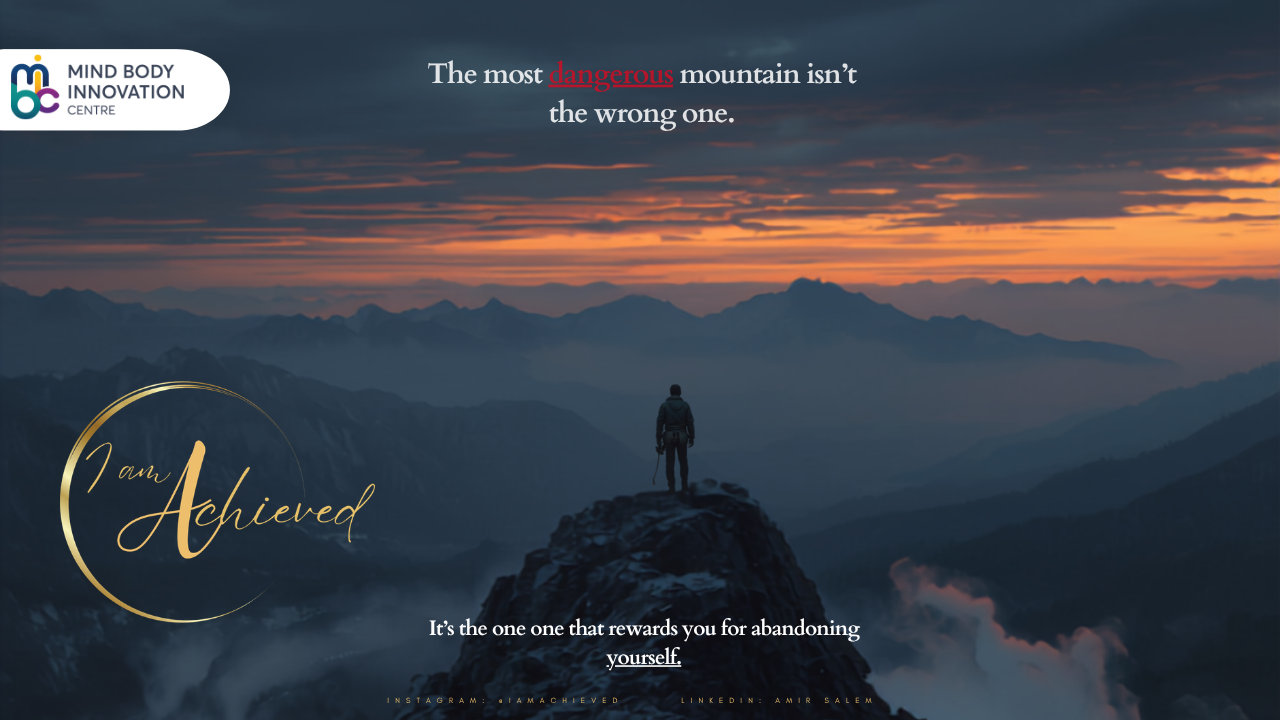
There is something I have noticed both in my own life and in many of the people I work with.
It took me a while to see it clearly because, on the surface, it looks like ambition.
It looks like discipline.
It looks like commitment.
In fact, most people would probably describe it as success.
But underneath it is something else:
Momentum.
Most goals are chosen at a particular point in time.
Often by a younger version of ourselves.
Sometimes they emerge from our own aspirations.
Sometimes they’re shaped by the stories we inherited.
The smart one.
The responsible one.
The achiever.
The creative one.
The dependable one.
Labels given to us by family, teachers, peers, and experiences that quietly become part of how we understand ourselves.
So we choose a mountain.
Not just because we want to climb it.
But because of what reaching the summit might mean.
Security.
Respect.
Recognition.
Freedom.
Proof that we are capable.
Proof that the sacrifices were worth it.
Proof that we became the person we hoped we would become.
The mountain makes sense.
So we commit.
We work hard.
We make sacrifices.
And because we’re capable, we build momentum.
Opportunities appear.
Responsibilities increase.
Progress compounds.
The path unfolds.
The Person Changes
What I wasn’t prepared for was this:
The person who chose the mountain doesn’t stay the same.
Life changes us.
Success changes us.
Failure changes us.
Relationships change us.
Parenthood changes us.
Loss changes us.
Experience changes us.
And yet the climb often continues uninterrupted.
I’ve felt this myself at different points in my career.
There have been times where I found myself pursuing something I had once wanted deeply, only to realise I hadn’t stopped to ask whether it still mattered in the same way.
Not because it was wrong.
Not because it wasn’t valuable.
Simply because I had changed.
The momentum remained.
The reflection had not.
The greater risk was slowly shaping myself around the climb.
Not in dramatic ways.
In small, reasonable ways.
The kind of compromises most capable people make every day.
Postponing things that mattered because there would be time later.
Ignoring signals that something felt off because there was work to do.
Allowing achievement to become the measure of whether a year had been successful.
Over time, it becomes easy to stop listening to parts of yourself that don’t seem useful for reaching the summit.
The interests that no longer feel productive.
The values that became inconvenient.
The relationships receiving whatever energy remained.
The parts of you that once felt alive but didn’t contribute directly to the climb.
This is what I think self-abandonment often looks like.
Not a single decision.
But thousands of small decisions that make sense in isolation.
Until one day you realise you’ve become exceptionally good at climbing, but you’re no longer certain why you’re climbing in the first place.
When Success Feels Different
I see a similar pattern in doctors, business owners, leaders, and professionals.
People who are objectively successful and yet quietly wrestling with questions they struggle to say out loud.
“Why does this feel different than I expected?”
“Why does this feel heavier than it used to?”
“Why am I less energised by something I worked so hard to achieve?”
Often they assume something is wrong.
That they’re burnt out.
Unmotivated.
Ungrateful.
Sometimes those things are true.
But often what I see is something far simpler:
A growing gap between who they have become and the direction they are still travelling.
A friend once described this as climbing a mountain.
At first, I didn’t think much of the analogy.
But over time, I’ve come to appreciate it.
Most people assume the problem is that they’re climbing the wrong mountain.
I’m not sure that’s always true.
Often, the mountain made perfect sense when they started.
The challenge is that the person who chose the mountain is no longer standing at the base.
They’re halfway up.
Or three-quarters of the way up.
They’ve gained experience.
Perspective.
Responsibility.
Wisdom.
And from that new vantage point, the summit can look very different than it did years earlier.
The question isn’t always:
“Am I climbing the wrong mountain?”
Sometimes the better question is:
“If I were standing at the base of this mountain today, knowing what I know now, would I still choose to climb it?”
Difficulty or Misalignment?
One of the hidden costs of achievement is that success can reduce the need for reflection.
When things are going badly, we naturally stop and reassess.
When things are going well, we tend to keep moving.
The better things get, the harder it can become to question the direction.
After all, you’ve invested years.
Built expertise.
Created a reputation.
People know you for this.
You know yourself for this.
Turning around doesn’t feel sensible.
It feels wasteful.
So the momentum continues.
But this is where I think many people get stuck.
Not because they lack discipline.
Not because they need another productivity system.
And not because they need to throw everything away and start again.
The self-development world often creates the impression that if something feels difficult, you must be on the wrong path.
I don’t think that’s true.
Some mountains are worth climbing.
Some responsibilities are worth carrying.
Some seasons are simply hard.
The challenge is learning to distinguish between difficulty and misalignment.
Those are not the same thing.
Before making major decisions, I think there are three questions worth asking.
1. Is the problem the mountain, or the way I’m climbing it?
Many people don’t need a different career, business, or role.
They need different boundaries.
Different systems.
Different expectations.
A different way of carrying the load.
2. Is the problem the summit, or the meaning I’ve attached to reaching it?
Sometimes the goal still matters.
What no longer works is the story we’ve attached to it.
The pressure to prove ourselves.
The pressure to keep everyone happy.
The pressure to justify previous sacrifices.
3. If this became easier tomorrow, would it matter again?
This is often the most revealing question.
If the answer is yes, the issue may be exhaustion.
If the answer is no, the issue may be alignment.
Becoming Deliberate Again
I think one of the most important skills we can develop is the ability to periodically reassess the assumptions guiding our lives.
Most organisations review strategy.
Good leaders review priorities.
Athletes review performance.
Yet many people never review the direction they are moving in.
They review calendars.
Emails.
Targets.
Budgets.
Performance.
But rarely stop to ask:
“Is this still the life I am intentionally building?”
Success tells us we are making progress.
Alignment tells us whether the progress still matters.
Both are important.
But they answer very different questions.
And in my experience, some of the most capable people I meet aren’t struggling because they lack momentum.
They’re struggling because momentum has replaced conscious choice.
So before setting the next goal, chasing the next opportunity, or committing to the next chapter, it may be worth asking yourself something simple:
If I were standing at the base of this mountain today, knowing what I know now, would I still choose to climb it?
Because the goal isn’t to abandon the mountain every time the climb becomes difficult.
The goal is to ensure the mountain still belongs to you.
And perhaps just as importantly, that you haven’t abandoned yourself in the process of reaching the summit.
Because sometimes growth isn’t found in reaching the summit.
It’s found in pausing long enough to decide whether the summit still matters.
Lorem ipsum dolor sit amet, consectetur adipiscing elit. Cras sed sapien quam. Sed dapibus est id enim facilisis, at posuere turpis adipiscing. Quisque sit amet dui dui.
Stay connected with news and updates!
Join our mailing list to receive the latest news and updates from our team.
Don't worry, your information will not be shared.
We hate SPAM. We will never sell your information, for any reason.
